
Water plays a central role in food production. It is used to wash raw materials, prepare products, clean equipment, sanitize production lines, and manage process residues. But once water comes into contact with organic matter, oils, fats, suspended solids, and processing waste, it can generate a dense and difficult material that is not easy to remove or transfer.
In food processing plants, these residues can accumulate in tanks, channels, wastewater systems, flotation units, and collection points. If they are not removed efficiently, they may reduce storage capacity, cause clogging, increase odors, and create operational problems that interfere with production continuity.
For this reason, sludge management in the food industry is not only a wastewater issue. It is part of a broader operational challenge: keeping production processes clean, reliable, and efficient.
What is food sludge?
Food sludge is a variable mixture generated during food processing and wastewater management. It may contain process water, organic residues, fats, oils, grease, suspended solids, floating materials, and semi-solid deposits.
Unlike clear wastewater, this material does not behave like a normal liquid. Its consistency can change depending on the production process, the raw materials involved, the amount of grease or oil present, and the level of solids accumulated in the system.
In many cases, it is not only settled material at the bottom of a tank. It can also include floating grease layers, compact crusts, fibrous organic matter, sticky residues, and irregular deposits that are difficult to transfer with conventional pumping equipment.
This makes sludge from food processing one of the most challenging materials to manage in industrial wastewater and process water systems.
Where the residues form in food processing plants
Sludge and organic residues can form in several areas of a food processing plant. They are commonly found in wastewater collection tanks, equalization tanks, flotation systems, production drains, washing areas, and storage units used to collect residues before treatment or disposal.
The problem is particularly common in processes involving oily or organic by-products, such as olive processing, sauces, preserves, condiments, ready meals, vegetable processing, and other production lines where water comes into contact with fats, oils, fibers and suspended solids.
Over time, these materials may separate, settle, float or thicken. Floating grease layers can become compact, reducing the useful volume of tanks and making regular cleaning operations more difficult.
When accumulation is not managed properly, the plant may face slower water flow, repeated blockages, higher maintenance needs and more frequent waste removal operations.
Why this material is difficult to handle
The main difficulty is variability. The material can be liquid in some areas, dense and sticky in others and compact on the surface or at the bottom of a tank.
This variability creates several operational challenges. High viscosity makes suction more difficult. Grease and oils can form floating layers that are hard to break and transfer. Organic residues may generate odors and hygiene concerns. Suspended solids can settle and build up, while fibrous materials increase the risk of clogging.
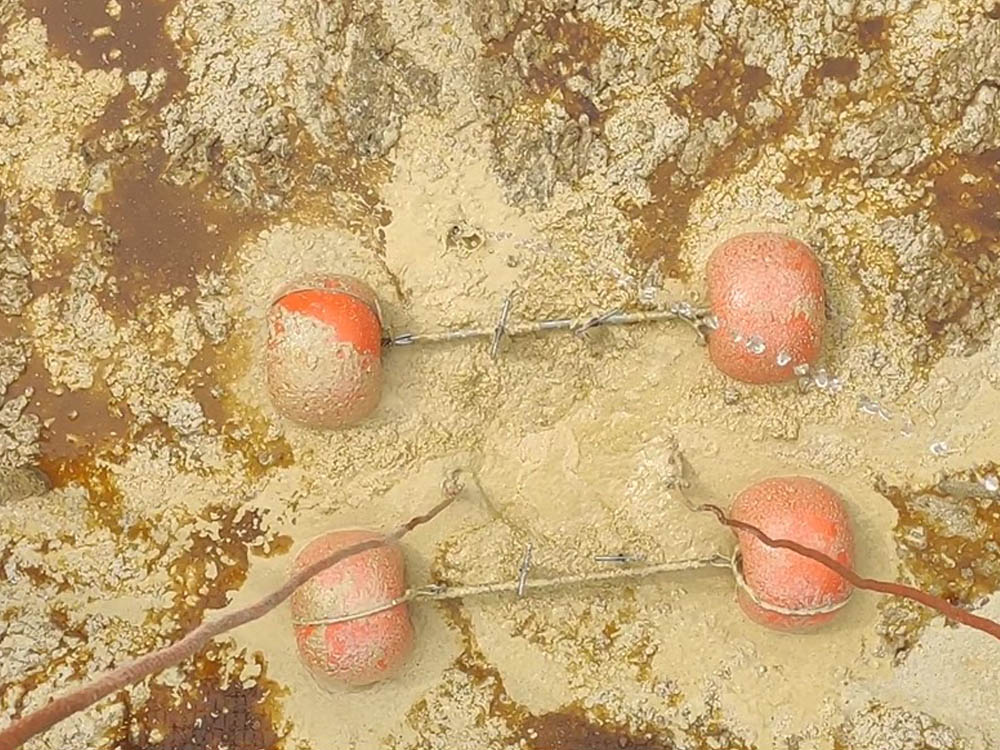
Floating grease and sludge residues can create compact surface layers that are difficult to remove with conventional pumping systems
In production environments, these problems are especially critical because cleaning and removal operations must be managed without interfering too much with plant activity. Long downtime, repeated manual interventions, or inefficient removal systems can quickly affect productivity.
For this reason, food processing plants need equipment that can handle dense, irregular and solids-rich materials with reliability.
Common management problems in production areas
When residues are not removed regularly, they can reduce tank capacity and affect the efficiency of wastewater management systems. Floating layers may solidify into crusts, making later removal more difficult and increasing the time required for cleaning operations.
Clogging is another frequent issue. Conventional pumps may struggle when sludge contains grease, fibers or compacted solids. In some cases, the system may lose suction efficincy or require filters, grinders or frequent maintenance to continue operating.
There is also a logistical problem. Many food companies rely on external vacuum trucks to remove sludge and floating materials. This method can be effective in some situations but it often depends on accessibility, maneuvering space, distance from the suction point and availability of the service provider.
When tanks are located in congested production areas or when the suction point is far from the vehicle, removal operations can become slower, more expensive and less efficient.
Limits of traditional vacuum truck removal
Vacuum trucks are widely used for sludge and wastewater removal, but they are not always the most flexible solution for food processing plants.
In industrial enviroments, access can be limited by production layouts, narrow spaces, equipment, safety areas or internal traffic. If the truck cannot get close to the suction point, long hose runs may reduce efficiency, especially when the material is dense, sticky or partially solidified.
Another limitation is scheduling. Companies often wait until multiple tanks are full before requesting an external service in order to optimize costs. However, this can lead to greater accumulation, harder crusts, stronger odors and more complex cleaning operations.
For frequent or localized removal needs, food processing plants may benefit from more flexible pumping systems that can be positioned closer to the problem and used when needed.
What food processing pumps need to handle dense residues efficiently
Not all food processing pumps are designed to manage sludge and floating residues. Many pumps used in the food industry are intended for cleaner fluids, homogeneous products or controlled process liquids. Wastewater residues are different.
A suitable system should be able to manage high-viscosity materials, floating grease layers, organic residues, suspended solids and mixed semi-solid materials without frequent clogging.
Strong suction capability is essential, especially when the material is dense or when the suction point is not easily accessible. The system must also be able to handle solids and irregular materials without relying on filters or grinders that may require frequent cleaning.
Mobility is another important factor. In many plants, the pump needs to be positioned near tanks, collection points or wastewater treatment areas. A compact system can make removal operations easier, especially when large vehicles cannot access the area directly.
This is where the distinction between standard food processing pumps and sludge-specific pumping systems becomes important. The goal is not simply to move liquid, but to remove and transfer difficult material that changes in consistency and composition.
For a broader overview of sludge technologies and application sectors, see our complete guide to sludge handling.
The TARUA ® approach to industrial sludge handling
In these applications, the most effective solution is often the one that combines suction power, full passage, mobility and the ability to transfer difficult materials without requiring filters or grinders.
TARUA ® is designed for this type of challenge. Its pumping principle allows dense, floating and solids-rich materials to be suctioned and transferred continuously, reducing the risk of clogging and helping operators manage sludge directly where it accumulates.
In food processing environments, TARUA ® can support the removal of floating sludge, grease layers, organic residues, crusts and mixed wastewater sludge from tanks and collection points. Its compact and wheeled configuration makes it easier to place the system close to the suction area, even in industrial spaces where large vehicles may have limited access.
This makes TARUA ® suitable for food companies looking for a pratical way to improve removal operations, reduce dependence on external interventions and maintain better control over wastewater management.
To explore how TARUA ® supports different production sectors, visit the page dedicated to TARUA ® pumps for industry.
Field application: removing concentrated grease from a full homogenization tank
A real intervention carried out by the IDEE E PRODOTTI team in an agri-food plant shows how floating grease and food processing wastewater residues can be managed without interrupting plant operations.
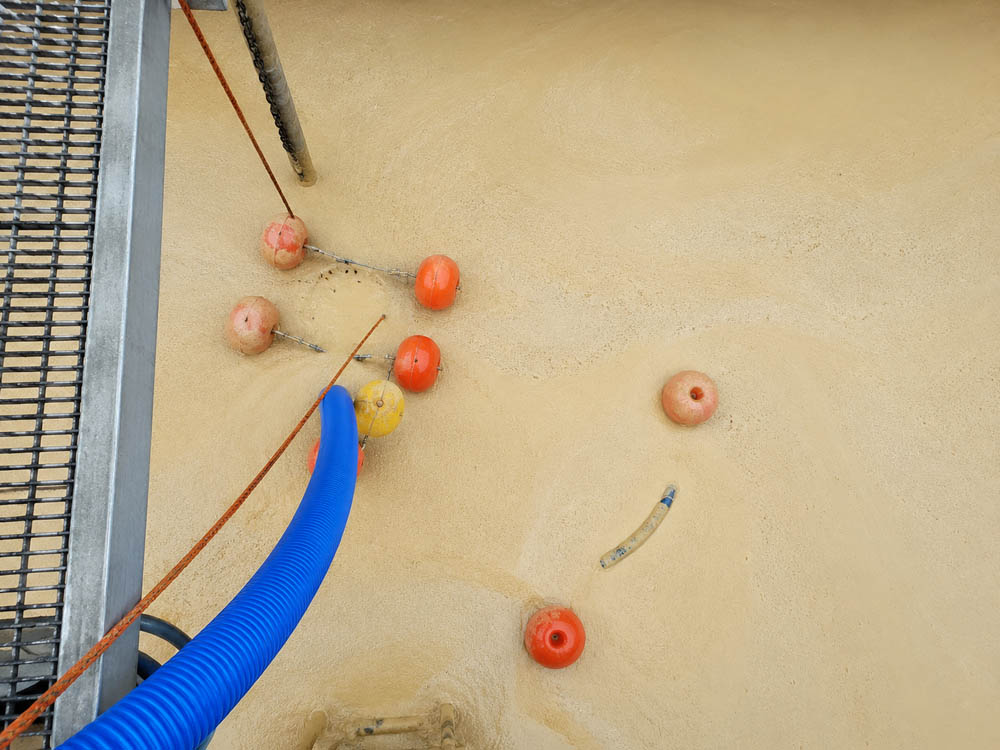
Detail of the floating suction accessory designed to remove only the superficial grease layer from a full homogenization tank
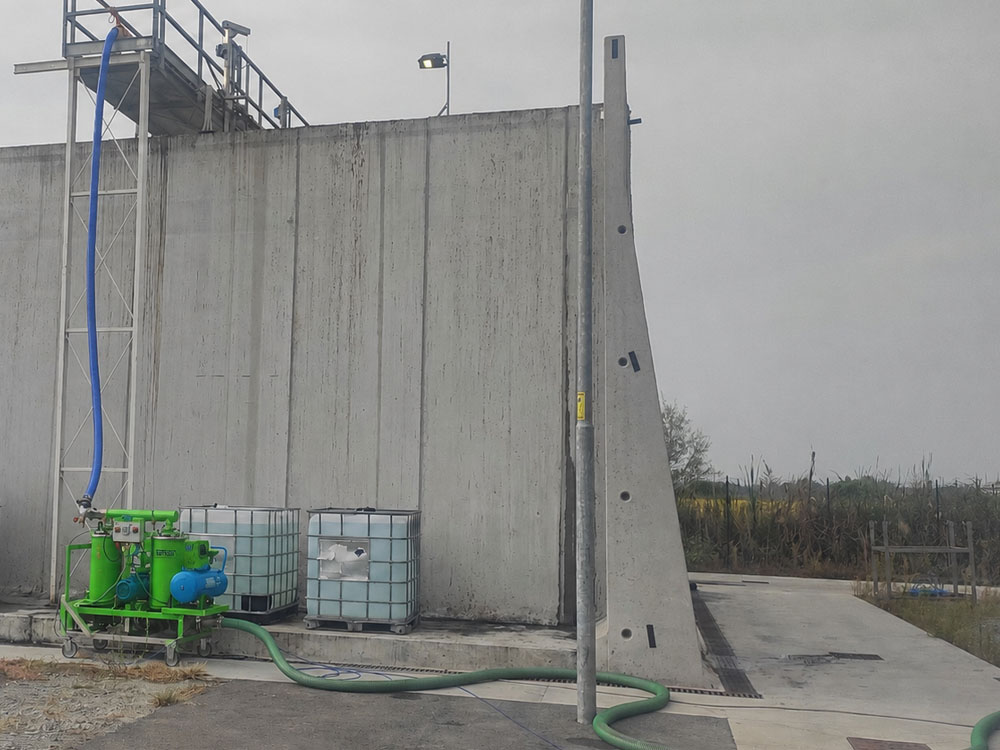
In this application, the TARUA ® pump was positioned outside the wastewater treatment plant and at the base of the homogenization tank. Thanks to its vacuum capability, the system suctioned only the upper layer of concentrated grease, approximately 5-10 cm thick, from a height difference of 6 metres.
The extracted grease was then transferred to a tank located 30 metres away.
The cleaning operation was carried out with the tank full, avoiding both plant shutdown and confined space entry. To remove only the superficial grease layer, a dedicated floating suction accessory was developed and installed on the suction line of the TARUA ® self-priming pump, wich is also able to run dry.
Watch the video of TARUA ® removing concentrated grease from a full homogenization tank.
Applications in food processing plants
Sludge and wastewater residue management is relevant across many areas of the food industry. It can involve plants that process vegetable, sauces, preserves, oils, condiments, ready meals and other products where water, organic matter, fats and solids are part of the production cycle.
In these environments, removal operations may be required from wastewater tanks, process water collection points, equalization tanks, flotation systems and temporary storage units used before disposal or treatment.
The operational goal is always the same: prevent accumulation, reduce clogging, maintain useful tank volume and support more reliable wastewater management.
When handled with the right pumping technology, food sludge can be removed more efficiently and transferred to storage, treatment or disposal systems with less manual intervention and lower operational disruption.
Benefits of efficient sludge management in food industry
Efficient management can improve several aspects of plant operation. Keeping tanks and collection points free from excessive accumulation helps preserve system capacity and reduce the risk of blockages.
It can also support better hygiene control by limiting the buildup of organic residues, floating grease layers and materials that may generate odors. From an operational point of view, more reliable removal can reduce downtime, simplify maintenance and help operators respond faster when accumulation becomes critical.
For food processing plants, the value is not only in removing waste. It is in keeping the production environment more controlled, efficient and easier to manage.
Frequently asked questions about food processing sludge
What is food sludge?
Food sludge is a mixture of water, organic residues, fats, oils, grease, suspended solids and semi-solid materials generated during food processing and wastewater management.
Where does it come from?
It can come from washing operations, production residues, process water, wastewater tanks, flotation systems and cleaning activities in food processing plants.
Why is it difficult to pump?
It is often viscous, sticky, solids-rich and variable in consistency. It may contain grease layers, crusts, fibrous matter or settled solids that can clog conventional pumping systems.
Are all food processing pumps suitable for this type of material?
No. Many food processing pumps are designed for cleaner or more homogeneous fluids. Dense wastewater residues require systems capable of handling irregular, viscous and solids-rich materials.
What is a food sludge pump used for?
A food sludge pump is used to remove and transfer sludge generated in food processing plants, including floating grease layers, organic residues and wastewater sludge.
How can better management improve plant efficiency?
Regular and effective removal helps reduce clogging, maintain tank capacity, limit odors, decrease manual intervention and support production continuity.
Conclusion
Food sludge is a common but complex challenge in food processing plants. Its combination of water, grease, organic residues, suspended solids and variable consistency makes it difficult to manage with standard pumping systems.
Choosing the right approach can help reduce clogging, improve wastewater management, maintain tank efficiency and limit operational disruption.
For food companies, effective sludge handling is not just a maintenance activity. It is part of a more reliable and controlled production environment.
Looking for a better way to manage sludge from food processing?
Every food processing plant has different wastewater and sludge handling requirements. Understanding the material, the operating conditions and the layout of the plant is essential to identify the most suitable solution.
Get in touch with our team to discuss your sludge management needs and evaluate the most effective approach for your application.
Stay updated on sludge handling technologies
For technical insights, real-world applications and project case studies, follow us on LinkedIn and subscribe to our YouTube channel.
Want to receive technical insights directly in your inbox?
Stay informed about sludge handling solutions, industry applications and technical updates from IDEE E PRODOTTI.
