
How it is made
Industrial pump construction:
the two circuits of a self-priming pump
The TARUA ® industrial self-priming pump consists of two separate circuits: the service hydraulic circuit and the pumping circuit.
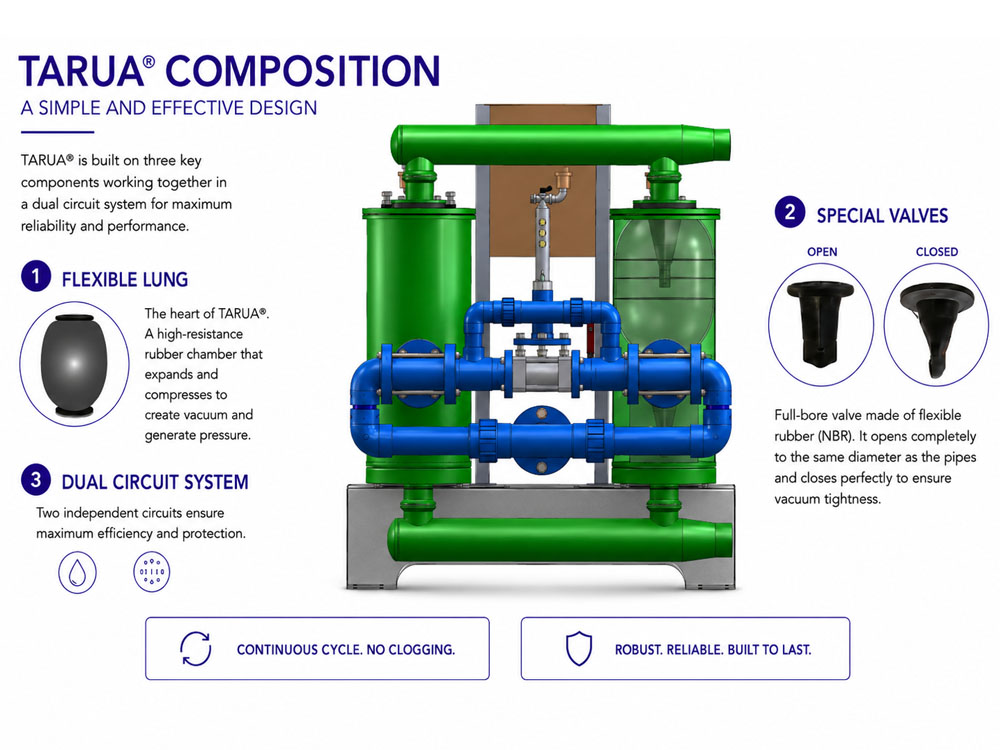
HYDRAULIC SERVICE CIRCUIT
It is the circuit exclusively devoted to moving the service fluid from one cylinder to another. This movement drives the expansion and compression of the membrane. An electric centrifugal pump is used to move the service water — which drives the full-passage self-priming pump TARUA ®.
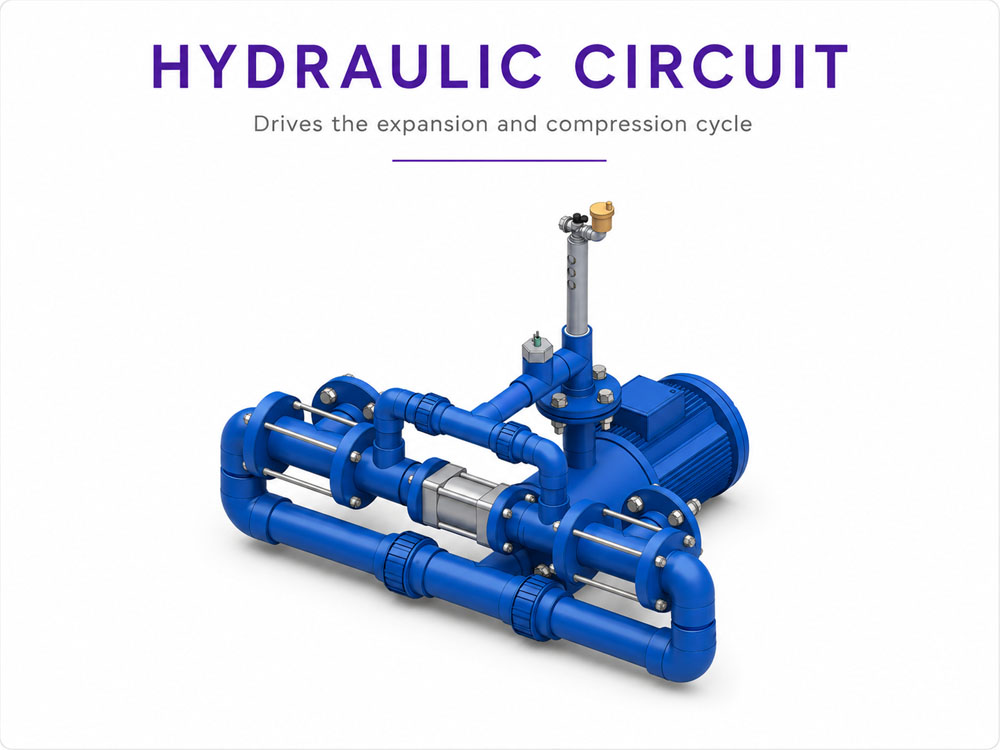
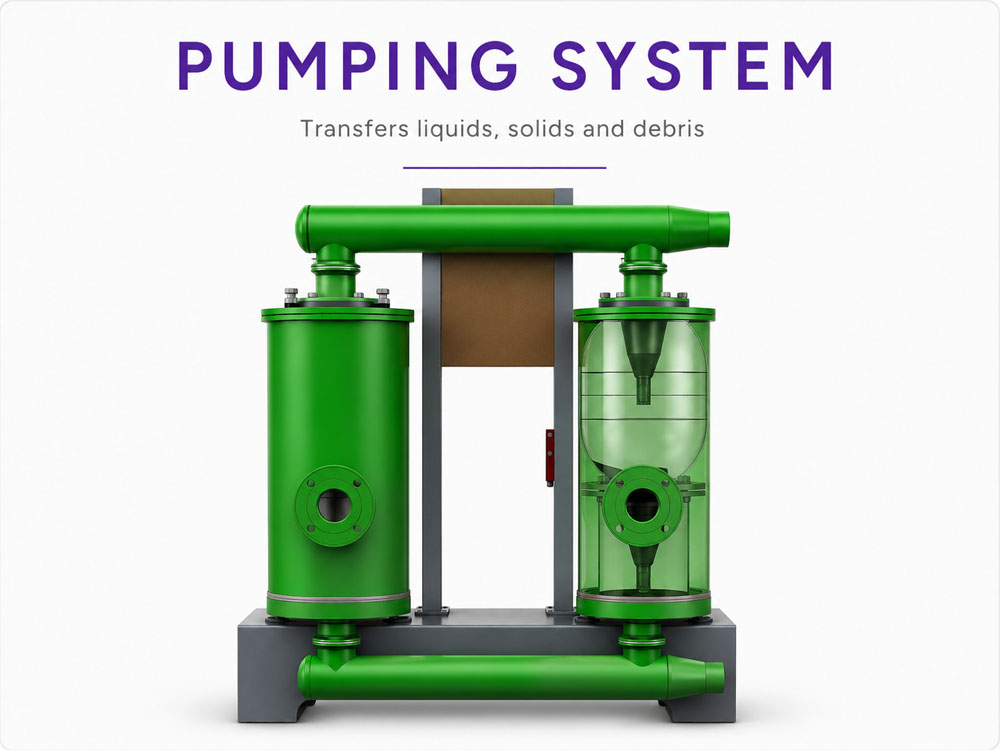
PUMPING CIRCUIT
This is the circuit devoted exclusively to product transfer. The cylinder contains the service liquid in which the membrane and sealing valves are immersed. The pumping effect of TARUA ® is generated by the compression and expansion of the membrane, which occurs due to the displacement of the service liquid (H2O). By introducing the service liquid inside a cylinder, the membrane is compressed — delivering fluid to the outlet. By extracting the service liquid, the membrane expands, creating the vacuum necessary for suction.
THE “LUNG” OF THE PUMPING CIRCUIT
TARUA ® is also a programme of industrial volumetric self-priming pumps known as “lung pumps.” The technological innovation lies in the lung-valve combination. The “lung” is manufactured in NBR rubber to ensure the flexibility required for continuous and rapid compression and expansion cycles. Its diameter is sixteen times larger than that of the valve, allowing large solids to pass through smoothly towards the outlet during the compression phase. The “lung” was designed and manufactured exclusively by IDEE E PRODOTTI.

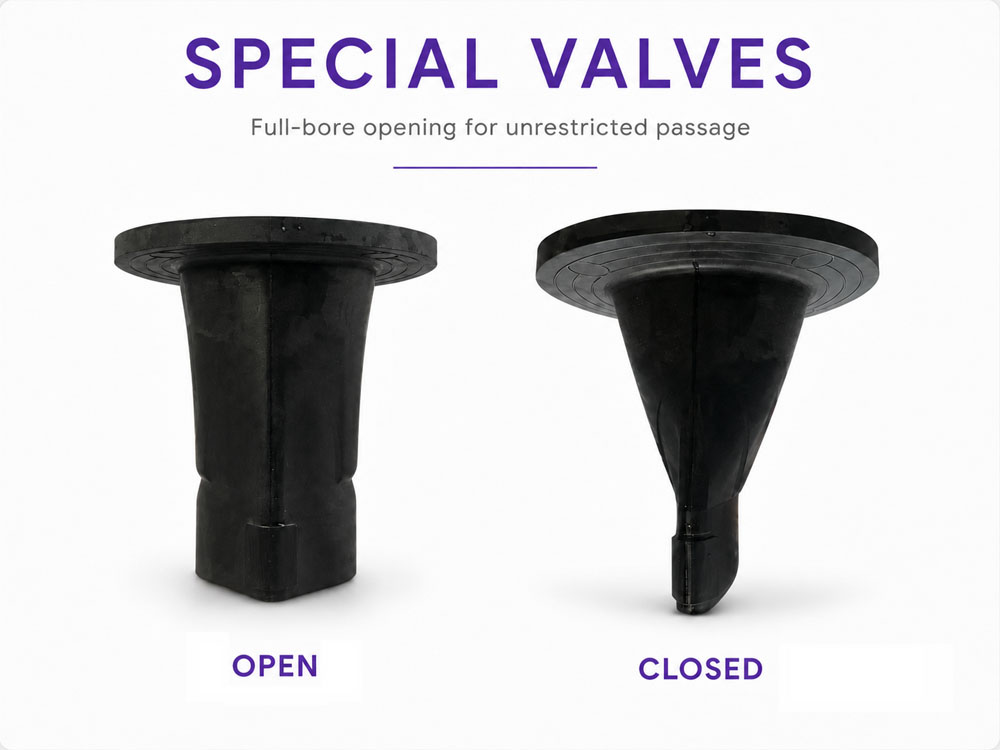
THE KODRILL VALVE OF THE PUMPING CIRCUIT
The KODRILL check valve plays a critical role in the operation of TARUA ® industrial self-priming pumps. Installed at both ends of the membrane, it performs two essential functions: sealing the membrane chamber and allowing the smooth passage of large solids without blockage. The valve is manufactured in NBR rubber to ensure the flexibility required for continuous and rapid opening and closing cycles. It must open fully — to the full diameter of the suction pipe — and close with a perfect seal to maintain vacuum integrity. In the closed position, it operates as a standard duck-bill valve. The KODRILL valve was designed and manufactured exclusively by IDEE E PRODOTTI.
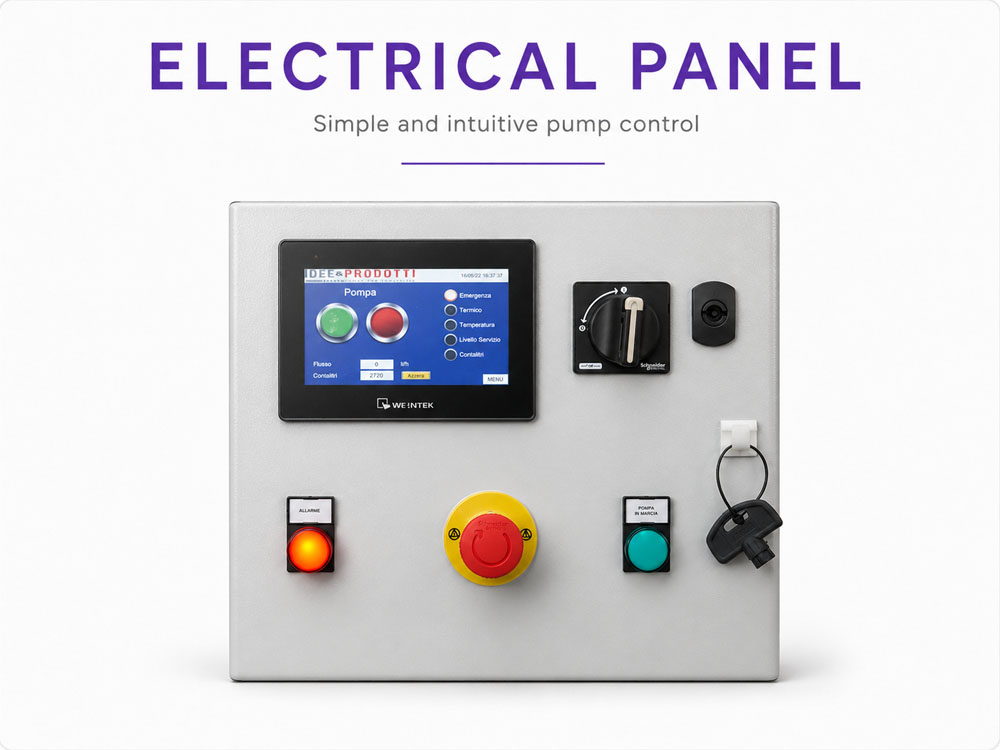
TARUA ® SELF-PRIMING PUMP ELECTRICAL PANEL
The TARUA ® self-priming pump is provided in two main versions: the Standard and the Industry 4.0. The two versions feature specific switchboards for remote data management (pictured is the one for Industry 4.0). TARUA ® industrial self-priming pump is designed and manufactured exclusively by IDEE E PRODOTTI.
TARUA ® self-priming pump:
Italian engineering for demanding applications
Every component of the TARUA ® self-priming pump is designed to work as an integrated system — from the hydraulic service circuit that drives the membrane, to the KODRILL valve that ensures full-passage flow without clogging.
This construction philosophy reflects over 40 years of industrial R&D by IDEE E PRODOTTI: each element is engineered to maximise reliability, minimise maintenance requirements and ensure continuous operation even in the most demanding environments.
This is why TARUA ® requires no specialist tools for routine maintenance — the membrane and KODRILL valve can be replaced on site by the operator, without disassembling the entire pump body. A design choice that directly reduces downtime and total cost of ownership in industrial operations.
The result is an industrial self-priming pump capable of handling liquids, sludge and solids of any size — without filters, without shredders and without interruption. A pump built not around what is easy to manufacture, but around what operators actually need in the field.
Unlike conventional pump designs that rely on filters and shredders to handle solids, TARUA ® achieves full-passage flow through geometry alone — a simpler, more robust and more maintainable solution for industrial and environmental applications.
All TARUA ® components are designed, tested and assembled exclusively in Bernareggio (MB), near Milan, Italy.
For a complete understanding of how this construction translates into operational performance, see how TARUA ® works.

